Published 1st November 2026
Growing up, in my Punjabi household, we learnt that certain foods needed help digesting. We had a word for them: 'bai'.
The use of the word might vary by region or household but it locked-in an understanding that preparation of food is just as important as what you eat. While there might be differences, in general, the foods this refers to are those that are:
Hard to digest
Cause bloating
Rich/heavy
Leftovers
Foods that easily spoil
Something my mum taught us about ‘bai’ foods was that we can make them easier to digest by cooking them fully, preparing with spices and adding ginger.
This is the cornerstone of Ayurvedic nutrition advice too. Wherever possible, freshly-made, warm and spiced meals improve absorption and digestion of foods.
So now, one spice I make sure to have every day in some form is ginger.

What is Ginger?
Zingiber officinale is the scientific name given to this flowering plant. The rhizome (underground stem that produces roots and shoots) is the part we recognise and find in markets and shops.
Ginger can be found growing in tropical environments and is used widely across Asian cuisine.
But it has also been used as part of pharmaceutical products as it’s recognised to have medicinal properties. Think cough syrups and pain-relief balms.
Phytochemical Profile of Ginger
Ginger contains many bioactive components including:
Phenolic compounds e.g. gingerol, shogaol, flavonoids, tannins
Terpenoids e.g. saponins
These bioactive compounds are mostly what are responsible for the therapeutic actions described further down.
Nutritional Profile of Ginger:
Ginger contains a number of minerals that are essential for health including potassium, sodium, calcium, iron, zinc, manganese, selenium and copper.
Ayurvedic Qualities of Ginger
In Ayurveda, the properties of foods are understood by their qualities and for ginger, these are:
Taste (Rasa): Pungent
Thermal potency (Virya): Heating
Post-digestive effect (Vipaka): Sweet
Each of these will exert a slightly different effect. For example, the pungent aspect of it means it has a mobilising effect, cutting through dampness and congestion.
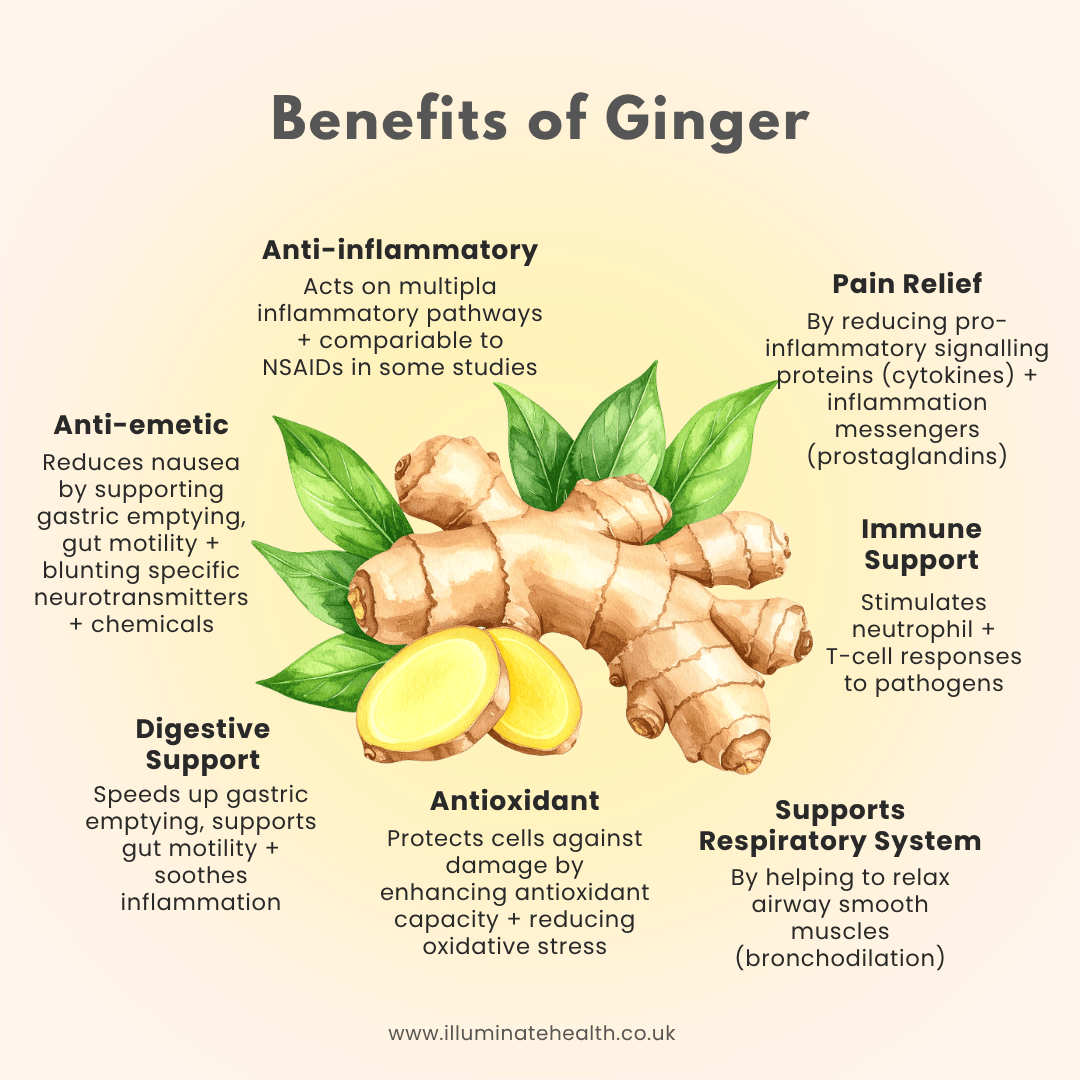
The Health Benefits of Ginger
The humble ginger root has so many benefits and uses beyond its culinary role. Here are just a few:
Ginger’s Antioxidant Effect
Modern life exposes us to a variety of environmental toxins which can stress out and damage our cells.
Glutathione is the body’s most abundant antioxidant and is involved in many actions including protecting cells from oxidative stress, supporting metabolic detoxification and cell regulation (1), and supporting the immune system (2).
Research shows that ginger enhances levels of glutathione in human and animal stressed cells (3, 4, 5, 6, 7).
A separate study also shows that ginger both enhances the total antioxidant capacity and reduces oxidative stress biomarkers when taken for a 10-week period (8).
Using a pesticide that is now banned in the UK due to its toxic effects, researchers studied the protective effects of ginger. Again, the findings showed that ginger exerted both a protective effect against oxidative stress as well as improving the activity of antioxidants, this time specifically in the brain, ovaries and uterus of rats (9).
Ginger for Digestive Support
The thermal energetics of ginger are naturally heating. From an Ayurvedic perspective, ginger stokes Agni (digestive capacity) in a healthy way, gently waking it up. Modern research backs this up, showing that ginger “settles” the stomach.
Ginger speeds up digestion and supports gut motility (10, 11), helping digestion tick along. This may explain why 51 patients in a study by Aregawi et al. (12) found improved symptoms of fullness, heartburn and pain in the upper abdomen after taking ginger supplements for four weeks.
Anti-inflammatory Effects of Ginger
Ginger reduces the production of pro-inflammatory mediators (nitric oxide; prostaglandin). It acts on a number of inflammatory pathways and specific immune cells to reduce inflammation, including stopping white cell activation and decreasing inflammatory signalling (13).
Studies shows that ginger is comparable with NSAIDs (ibuprofen, naproxen) in reducing inflammation in the body (see section below on period pain).
Ginger Supports the Immune System
The immune system is made up of lots of different cell types. Some are part of our innate immune system (first responders) and others belong to the adaptive immune system (specialists).
Studies show that ginger stimulates a greater response from human neutrophils (a type of immune cell) to bugs (14). So ginger fires up the immune system!
Ginger has also been found to enhance T-cell production (part of the adaptive immune system) without creating an overactive effect such as an allergic reaction, in animals with low immunity (15).

Ginger for Respiratory Support
Several studies show that ginger supports the respiratory system by helping to keep the airways open (bronchodilation).
Specific components of ginger have been found to relax airway smooth muscle. There have been several suggestions for how this happens including:
Blocking calcium from being triggered within the cell in response to inflammation which would normally lead to contraction (16)
Enhancing the airway muscle-relaxing effects of B-agonist agents (existing asthma therapy), suggesting its action on this pathway (17, 18)
Yet another study with 32 participants showed that ginger may reduce asthma-related inflammatory markers in people when used over a 2-month period (19).
An important point to make here is that ginger should not be used to replace prescription medication for any respiratory diseases and any changes made to medications should be discussed with your GP or specialist in the first instance.
Ginger as Pain Relief
The warming and anti-inflammatory properties of ginger make it an ideal companion for pain relief both internally and when applied topically. Studies show that ginger extracts decrease pro-inflammatory signalling proteins (cytokines) and prostaglandins (chemical messengers for inflammation) in joint inflammation (20).
Ginger for Period Pain
Ayurvedic practitioners often recommend ginger as an effective analgesic for menstrual pain. Understanding its anti-inflammatory properties, it’s now easy to see why.
One modern study compared the use of ginger to both mefenamic acid and ibuprofen (medications commonly taken for period pain) in 150 adult females. The results showed that ginger had a similar effect in reducing pain levels as the two pharmaceutical medications (21). It is just as effective and without the gastric side effects that are common with non-steroidal anti-inflammatory medications.
Anti-emetic Effect of Ginger
Ginger has been used widely for morning sickness in pregnancy and has also been used for motion sickness and chemotherapy or radiation-induced nausea. But ever wondered how this works? There are several suggestions:
By helping food travel along the gut quicker (10, 11), it can reduce nausea symptoms related to slow gastric movement.
By reducing the serotonin surge in the gut that signals the brain to evoke nausea (22, 23, 24)
By reducing excess dopamine levels in the gut which would normally slow gastric motility and cause nausea (23, 10, 24)
By blocking Substance P which binds to the NK-1 receptor in the brain’s vomiting centre (23, 24)
The antioxidant effect of ginger activates cytoprotective genes and reduces radiation-induced damage to stem cells (25). Free radicals and oxidative can contribute to nausea by causing irritation and inflammation.

Ginger Supports Gut Health
Aside from the skin, the gut is the organ that has the greatest interface with the outside environment and this makes it a vulnerable place that needs to be taken care of.
The lining of our gut plays an important role, selecting which nutrients pass into the bloodstream and which harmful bacteria or food particles don’t. It’s protected by mucous and tight junctions which hold it together. But when we are stressed, have an infection, consume unhealthy foods or drink alcohol, the integrity of this gut barrier can become compromised, allowing toxins into our general circulation.
Ginger protects against gut barrier dysfunction by blocking the TNF-a inflammatory signalling pathway (26, 27), one of the routes that make the gut lining more permeable or “leaky”.
Ginger has also been found to have a healing and anti-inflammatory effect where there is inflammatory bowel disease such as colitis (28).
Ways to Add Ginger into Your Diet
Ginger is Tridoshic, meaning that it supports all three Doshas. And it’s not just for savoury recipes - try some of these:
🫖 Brew a ginger tea
🥣 Add a pinch of ground ginger to your porridge
🍲 Add ginger to soups, stews and dhals
🥦 Thinly slice fresh ginger and add to stir-fried vegetables
🍪 Add dried ginger to baking – cookies, cakes, granola
☕ Add a pinch to your mug of hot chocolate
Queen of the Spices
Ginger really is a powerhouse ingredient. It’s easy to see why it’s considered the queen of spices in Ayurveda and has been extensively researched by modern methods.
Whether you’re experiencing digestive discomfort, joint pain or just want to support your health generally, ginger is easy to weave into your daily routine. Give it a try and see how transformative this common root can be.

Disclaimer:
This article is for educational purposes only and does not constitute medical advice. Always consult your GP if you are experiencing abnormal symptoms, especially if pregnant, nursing, or managing a health condition.