Health Doesn't Happen in Absolutes
I haven't stepped foot in a gym in years yet I'm probably fitter and healthier than I was 20 years ago when I went to the gym daily.
My HbA1c result (blood test for diabetes) dropped 8mmol/mol from this time last year and I never gave up carbs.
My triglycerides and LDL cholesterol results have come down from last year’s test and I eat saturated fat regularly.
If health advice was as simple as the headlines suggest, these results shouldn’t make sense. I've also seen many patients with these sorts of confusing outcomes that go against what we’re told works. And that's because health is dynamic and there's no one way to do it.
Yet everywhere you look, it's "The best food for [insert condition here]", "The ONLY exercise you need”, "The ONE thing that changed my health/life" or “Eat this every day and you’ll never feel [insert problematic symptom] again.”
‘Always', 'never', all-or-nothing, 'totally' – we're surrounded by sound-bite health and wellbeing content that's big on telling us what we must always and never do.
Something that can create this disconnect between our lived experiences and popular health advice is a cognitive pattern called absolutist thinking.
What is Absolutist Thinking?
Absolutist thinking is a mental pattern where we interpret experiences in rigid terms. There is no middle ground, grey area or room for nuance.
Take a case of someone building a new health habit into their daily routine e.g. sitting down for breakfast, without their phone in hand. One day, they might be on autopilot and dash out the door while eating, or they might check their phone at their mealtime. If they have an absolutist way of thinking, they instantly see that scenario as a “complete failure” and may even give up on their goal.
Someone with a more realistic outlook is more likely to think “It’s not the end of the world and I’ll just make the effort to sit down for breakfast tomorrow.”
💭Types of absolutist thinking:
Dichotomous thinking – Categorising ourselves, others and situations into rigid groups of “good”, “bad”, a complete success or total failure. Also known as ‘all-or-nothing’ or ‘black-and-white’ thinking.
Categorical imperative – Rigid rules or expectations we place on ourselves and others. Includes words such as “should”, “must”, “always” and “never”
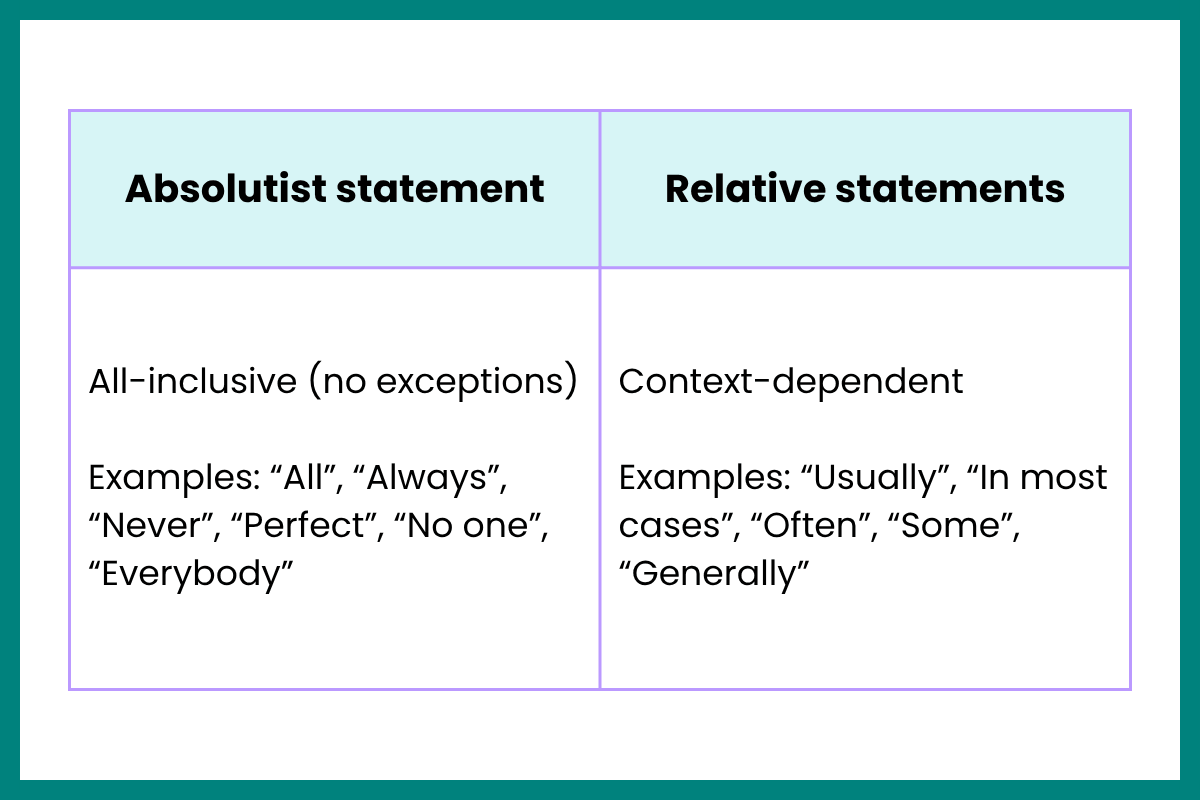
Recognising these patterns can be useful but if we don’t actually catch ourselves in the moment, they can become unhealthy.
Why Absolutist Thinking Is Unhealthy
Thinking in absolutes can be unhealthy for our mindset as it can stifle growth. When a person thinks in this rigid way, it's not easy to be curious and see other possibilities for themselves. Ostell and Oakland (1999) found that this type of thinking can dampen our view of ourselves or our capability when it comes to health.
It’s also a pattern of thinking that research shows has been linked with mood disorders. In 2018, Al-Mosaiwi and Johnstone analysed the content of 63 internet forums and found that forums on anxiety and depression contained more absolutist words than control conditions. In fact, they found absolutist words reflect the severity of a mood disorder better than usage of negative emotion words.
The same pattern emerged for spoken language (Bauer et al., 2026) with greater absolutist language used by people with depression when describing their mood.
Even where there isn’t a case of mood disorder, when we think in absolutes, our emotional intensity is amplified. In this heightened state, it's difficult to think with clarity and logic. Then we become even more frustrated as we don't give ourselves the space to even consider and explore alternative explanations or options. I heard a psychiatrist recently sum this up perfectly:
“When we have an emotion that is very very strong, you are more convinced…if we quiet the emotion, then It opens up the door of cognitive flexibility.” ~ Dr Alok Kanojia
That said, there are circumstances where an absolutist mindset can serve a purpose. It’s a matter of knowing when it’s helpful or not to use.
When Can Absolutist Thinking Be Helpful?
Recognising and facing the nuances and complexities of life places more demand on our thinking as we have to hold two or more possibilities or realities in tandem. So maybe those of us who have an absolutist outlook are 'cognitive misers' (Fiske and Taylor, 1984), reducing mental effort by simplifying scenarios.
Or maybe it’s just part of our design as humans. We are all, to different extents, absolutist. Why? Because humans inherently want the quick or easy way out, reducing decision fatigue. Think about everyday decisions we make. How often do we cut corners and make snappy decisions because we don't have the time?
This approach is also helpful in circumstances where there are workplace ethics, zero-tolerance policies and other rules and guidance.
This is probably why internet content designed with catchy, absolutist tag lines end up receiving more attention. They’re created this way. But for decisions around other aspects of our lives, such as health and wellbeing, absolutist thinking could hinder or limit us.

Foundations Over Fads
The thing is, our health, like everything in nature, is fluid. Our minds and bodies are constantly talking with our surroundings and adapting.
What I love about Ayurveda is that it doesn't do absolutes. It appreciates balance, individual differences, changing external circumstances and the unpredictable nature of life.
However, it does teach us that there are best practices that work more effectively than others. General principles which can then be tailored specifically to each person.
These underlying principles that are a running thread through much of the advice include:
🍲Real food
🤸🏾♀️Movement
☀️Rise with the sun
🌙Rest with the moon
☕Connection with others
🌳Spend time outdoors
🎨Find a creative outlet
When we understand the principles, we can navigate or even break the rules from time to time.
Take my client – a lady who was experiencing painful bloating and did a fair bit of travelling for work. Together, we worked on understanding her digestion, reflecting on her habits, exploring the way she prepared her meals, incorporating supportive drinks or herbs and thinking about her mealtime routine.
After implementing these lifestyle changes and building consistency, she was able to travel and her body could tolerate the temporary shifts in environment and diet that came with it. It's like the 80/20 rule where 80% of the time, you follow your routine (consistency) and this then allows wiggle room (that remaining 20%) to experiment or be spontaneous without it creating too much disruption for us.
Adaptable principles instead of rigid rules. Because health isn’t about following rules perfectly. It’s about foundations (in rhythm with nature).
How to Break from Absolutist Thinking
This way of thinking is something we’ve all experienced. But, if it’s something that is causing you and those close to you any concern, consider speaking with a professional in the first instance.
Here are some small self-help ways we can all try to challenge our fixed thinking around health:
🔍Check the evidence – Instead of making sweeping statements about people, places, circumstances, read around it to get a balanced perspective.
👐🏽Be open to change – For example, instead of thinking "it'll never happen", think "it hasn't happened YET"
👂🏽Monitor the usage of words – Do you catch yourself frequently using words such as “always”, “never”, “failure”?
Key Takeaways
Health doesn’t happen in absolutes. My own results, my client’s experiences and research all point to this. Yes, absolutist language might grab our attention, but it doesn’t really reflect how our bodies work in our own lives. Next time you catch yourself going down the path of using ‘never’ and ‘always’ in health conversations (even with yourself), pause and ask if there is a middle ground or different perspective that can be explored.