Tending to Our Mind: The Ayurvedic Perspective on Mental Health
A few weeks ago, I joined Nesha Mistry on the Vulnerable Voices podcast. The conversation touched on the topic of mental health and how Ayurveda approaches this. This prompted me to write about the Ayurvedic view on mental health and why I think it's so much more comprehensive than what's often offered by mainstream services.
Definition of Health
In Ayurveda, the term for health is 'Swasthya'. It is made up of two Sankrit words: 'Swa' meaning 'myself' and 'sthya' meaning 'to stand' or 'to be established'. So Swasthya means 'rooted in myself'. This is a beautiful definition of health because it sees and promotes health as something we already have and carries a sense of being at home with ourselves.
There are seven components to Swasthya according to Ayurveda:
Balanced Doshas
Regulated metabolism (Agni)
Healthy functioning tissues (Dhatus)
Healthy elimination (Malas)
Satisfied senses
Contented mind
Contented soul
Illness, according to Ayurveda, arises when there is improper use of the body, senses, mind, speech or time.
As a nurse, I have seen how even slight dysfunctions can lead to downstream effects for the body and mind. Take constipation for example - it's so common and yet it can cause confusion for the elderly or very young. This clearly shows how our excretory functions should not be overlooked in terms of our overall health.
Similarly, the senses, according to Ayurveda are our gateway to the world around us. Any imbalance can distort our perception and digestion of incoming information.
What is Mental Health?
The World Health Organisation (WHO) defines mental health as:
"a state of mental well-being that enables people to cope with the stresses of life, realise their abilities, learn and work well, and contribute to their community. "
Ayurveda expands on this by recognising mental stamina (Pravara) - our ability to adapt to difficulties. It also appreciates that mental health is not fixed and sits on a continuum. It requires continual adjustment, mental agility and compromise with our environments and relationships.
In this article, we will focus on two of the most common challenges today: depression and anxiety.

Symptoms as Signals
Today, anxiety, burnout, and depression have become a norm in clinic rather than an exception. Fast-paced lives, overstimulation and unfair demands on our time lead to depletion and restlessness.
Modern psychology and medicine places much of the attention on brain chemistry and our thoughts. Ayurveda takes a unique approach addressing our mental, physical and spiritual sides as interconnected. The Mano-vaha srota (channel of the mind) flows through the whole body, linking mental and physical wellbeing. Today's 'gut-brain axis' and 'psycho-nutrition' research echoes this.
Our mood and mental state, just like our skin or immune system producing reactions, reflects how well we are living in alignment with ourselves.
Understanding the Roots of Mental Imbalance
To take an integrative view, Ayurveda and modern medicine both identify multiple causes for mental health disturbance:
Modern medical perspective:
Traumatic events (abuse, grief, neglect, witnessing violence, adverse childhood experiences)
Social circumstances (living conditions, poverty, discrimination, isolation)
Biological and genetic factors (neurological conditions, brain injuries, infections, certain medical conditions)
Lifestyle factors (sleep, nutrition, substance use)
Medication side effects
Additional factors identified by Ayurveda:
Improper use of the senses (overconsumption, overwhelming, sensory deprivation)
Prajnaparadha (acting against our inner wisdom)
Living out of sync with the natural cycles (Kala)
Ayurveda would also consider the points made further above about what factors lead to illness such as imbalance in the Doshas.
Each of us responds differently to life's demands. Ayurveda helps us understand individual patterns that influence our mental wellbeing.
The Mental Influence of the Doshas
The three doshas represent essential physiological functions in our body (catabolism, metabolism, accumulation). However, they also carry psychological patterns.
Vata Dosha
When balanced, this Dosha gifts us the capacity for creativity. How we channel that creativity matters - Do we channel it for generating positive and useful ideas or to create imaginative 'what-ifs' and anxiety in our mind? Physically, an imbalance of Vata Dosha may also lead to depletion, deficiencies or nervous system irregularities, all which are known to impact mental wellbeing.
Pitta Dosha
In health, this Dosha gives us the clarity and precision needed for decision-making, deciphering and understanding. However, this level of intensity can easily spill over into perfectionism, irritation and being judgemental. In the physical body, this will show up as inflammation. Research shows that chronic inflammation can impact the body's stress response and elevated inflammatory markers have also been linked with depression and anxiety.
Kapha Dosha
This Dosha offers steadiness, patience, nurturing and memory. However, an imbalance here can skew the holding or glue-like quality, leading to scenarios where a person might have difficulty letting go such as hoarding, OCD, procrastination, depression and emotional attachment.
Understanding our unique Prakriti (constitution) gives us insight about ourselves. It helps us nourish our body and mind through supportive foods, routines, herbs and lifestyle measures.
The Three Gunas: Qualities of the Mind
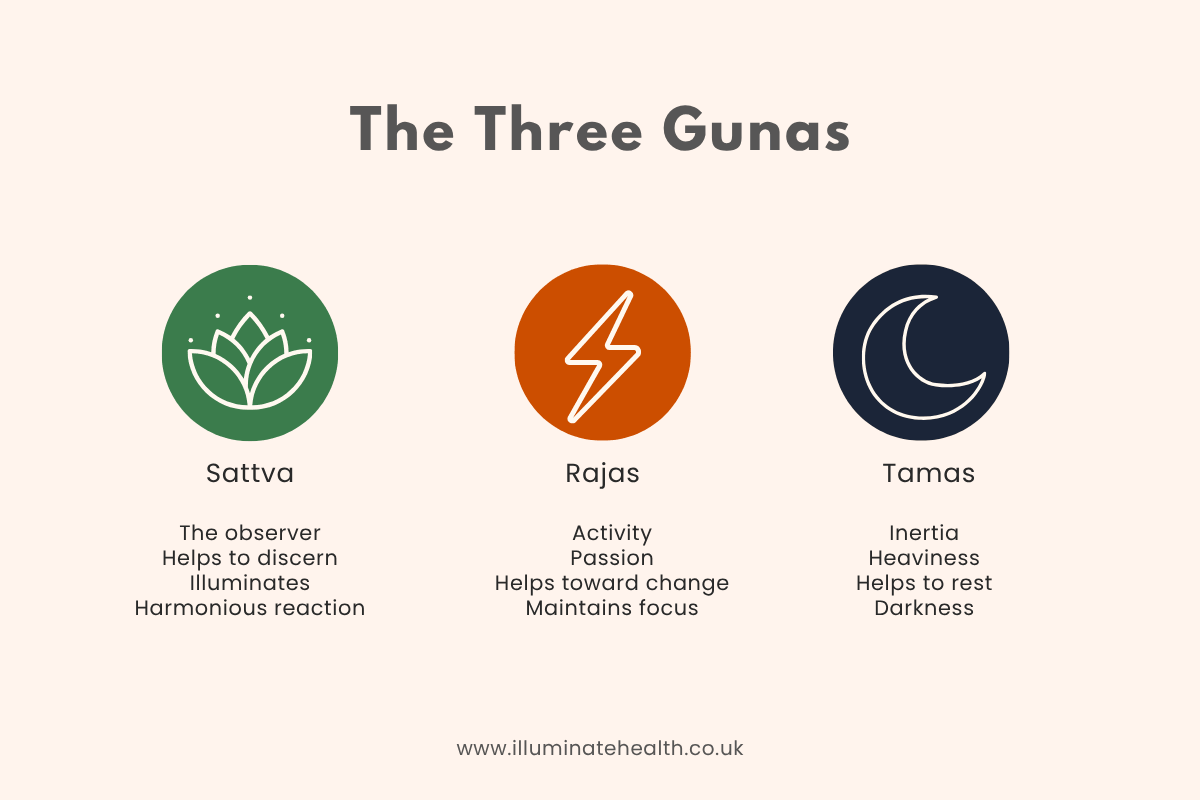
As well as our unique mental constitutions (Doshas), we can go through phases of feeling active, lethargic or just at ease. In Ayurveda, these qualities of our mental state are called the Gunas.
Sattva - All illuminating clarity, awareness, harmony and intelligence
Rajas - Restlessness, activity, drive to help towards change
Tamas - Inertia, stillness, darkness to allow rest
A balanced mind needs all three. Sattva allows us to discern when we need to use Rajas (action) or Tamas (rest). Often, when we are feeling overwhelmed or confused, our ability to think clearly, or make decisions becomes harder. In these moments, we might misjudge the appropriate action to take, and it is here when we might fall into unhelpful Rajasic (agitation) or Tamasic (apathy) behaviours. We can think of them as maladaptive behaviours.
Ayurveda has a term for when we intuitively know the right action to take but decide not to anyway. Prajnaparadha means to betray or ignore our inner wisdom. Ayurveda sees the mind and body as inherently intelligent and always relaying information to us. It is up to us to act on it.
The Heart-Mind Connection
In Ayurveda, the heart and mind are intimately connected. The heart is seen as more than just an anatomical pump. It is described as the 'seat of consciousness' and is the root of the Mano-vaha srota. Emotional upset, stress, fear and anger can strain the heart and disrupt its natural rhythm. In the other direction, reduced blood flow and blocked channels of the heart can affect emotional stability and mental clarity.
Unlike other organs, the heart is unique in that all three Doshas play a role in its function. Vata Dosha is responsible for the heart's movement, electrical impulses and maintains its steady heartbeat. Pitta Dosha regulates the body's temperature and ensures healthy blood circulation. Kapha Dosha provides the heart stamina and resilience with its quality of endurance.
When any of these Doshas are out of balance, it can impact our heart in different ways. For example, excess Vata in our lifestyle such as an erratic routine, skipping meals or a lack of sleep can all disturb the heart's rhythm. The person may experience symptoms such as palpitations or anxiety. Excess Pitta Dosha in our lives could look like working in highly ambitious environments, increased stress, anger and burning the candle at both ends. This type of lifestyle can catch up with us and lead to inflammation and high blood pressure. An excess of Kapha Dosha can take the form of a sedentary lifestyle or overindulging in rich and heavy foods. We can see how this would put pressure on our heart physically with channel blockages and raised cholesterol. But, from an emotional perspective, we may feel heavy in the chest area and carry a sense of stuckness.
Capacity over Categories
Today, it is easy to get lost in the web of mental health diagnostic criteria. While Ayurveda does recognise specific symptoms and conditions, the overall aim of Ayurvedic approaches is to build our capacity to hold reality and have the stamina to withstand the fluctuations within and outside ourselves.
It focuses on the importance of digesting and processing reality (Manas Agni) and re-establishing this ability. Unprocessed emotions, experiences and thoughts can congest our channels just as physical matter does. This leads to mental Ama (toxic overload) which clouds the mind and its resilience.
A Holistic Assessment in Ayurveda
Ayurveda truly shines when it comes to mental health because it takes a 360-view of our lives and all the potential influential factors.
In addition to the usual initial consultation and history-taking, here are some of the areas Ayurveda considers during an assessment:
Physical activity - How much physical activity is the person engaging in daily? Are they mostly sedentary or overly active?
Circadian alignment - Numerous studies show the role of the circadian rhythm in supporting our overall health. From immunity to mood and hormonal health, our sleep-wake cycle is key.
Digestion and gut health - One of Ayurveda's core teachings is that digestion and mental health are closely linked. Ahamkara is our sense of 'I am' but when our Agni is weak, our sense of self can also weaken. Modern science consistently finds that people with depression and anxiety have an imbalanced gut microbiome and leaky gut. Restoring gut bacteria to a healthy composition shows improvement in mood and behaviour. So, re-establishing Agni is vital for our mental health.
Nutrition and meal timing - To maintain healthy digestive function, our choice of food plays a key role. The frequency of a person's mealtimes or whether they generally skip meals and have an erratic eating pattern will also be explored.
Sleep - Ayurveda considers quality rest and sleep a core aspect of health. Numerous studies today show how disrupted sleep, sleep deprivation and even inconsistent sleep times can impact both our physical and mental health.
Relationships and social connection - Today we hear the phrase "You are the sum of the five people you spend the most time with" and this is exactly what Ayurveda was pointing to. It asks us to reflect on who we keep company with and whether we are socially isolated.
Work satisfaction and purpose - Our employment, whether for ourselves or an organisation, is often where many of us spend the majority of our waking hours. How do we feel about this? Are we satisfied at work with a meaningful sense of purpose? What hours do we work? Are we working unsociable or variable shift patterns?
Our five senses - As the portal to how we experience the world around us, our five senses are key to our quality of life. In our modern-day lives, we are exposed to multiple sources of incoming information at rates we could only imagine a few decades ago. This overstimulation of our senses can leave us feeling frayed at the edges and hyper-sensitive. Sometimes, it can leave us feeling like we want to disengage altogether. During a consultation, expect to be asked questions about your five senses - how well they are functioning or if we are experiencing any sensitivity or dullness.
Medications - Prescription medications can have side effects that impact our mood. Aside from the obvious ones such as anti-depressants, others include hormonal contraceptives, anti-epilepsy medications, steroids, some pain killers (opioids) and some asthma inhalers.
Recreational drugs - Drugs and alcohol all influence our nervous system and mood. They also have the potential to create dependency.

Ayurvedic Approaches for Mental Wellbeing
So, how do we build our mental stamina and capacity? Depending on the person's unique circumstances and what they would be most amenable to, Ayurveda would take a multi-modal approach including but not limited to the following areas:
Movement
Ayurveda prescribes physical activity according to a person's need and capacity. There is a lot of modern research showing how physical activity is just as, if not more, effective than anti-depressants. Beyond the endorphins, hormone support, immunity boost and vigour it gives us, movement keeps us in-the-moment. And if it’s outdoors, even better! Additionally, from an Ayurvedic perspective, healthy muscle tissue (Mamsa dhatu) supports our mental health in terms of our confidence to step forwards in life.
Breathing exercises (Pranayama)
The breath carries our vital force (Prana) which nourishes all our tissues. Which type of breathing exercise is beneficial would depend on the person's need. For example, invigorating breathing exercises such as Bhastrika can help with lethargy and depression, whereas alternate-nostril breathing can calm the nervous system.
Mantra therapy
Repetitive sound chanting has been used in cultures across the world for thousands of years. Today, scientific research shows that the rhythmic movement of sound can bring about a feeling of calm, focus, and has even been linked to a reduction in stress, anxiety and depression. You can start simply with humming and see if you notice a difference.
Nutrition
It's not necessarily a Sattvic diet that will be right for everyone. In fact, if for example, the person is depleted of vital nutrients and is presenting with excess Vata symptoms, a diet based around bone broths and protein may be recommended. As a general recommendation that anyone can follow, Ayurveda suggests:
Take the main and largest meal of the day at lunchtime when Pitta is at its peak to help digestion
Consume foods that are in season (ritu ahara)
Avoid incompatible food combinations (Virrudha ahara)
Consume warm, cooked meals
Choose fresh foods. Highly processed foods have been linked to gut dysbiosis, leaky gut, as well as poor concentration.
Herbs
It would be easy to list a load of herbs that support our mind and nervous system such as beautiful Brahmi, Tulsi, Jatamansi or Saffron. But, in the first instance, it would be irresponsible of me because it is best to use these under guidance in case there are any contraindications. Secondly, Ayurveda views all disease has its roots in a weakened digestive capacity (Agni). Working with an Ayurvedic practitioner, rather than simply giving a nervine, nootropic or sedative-type herb, they would consider all aspects of your health. For example, malabsorption could be a key factor in someone's mental health or inflammation could be causing some of their symptoms. Simply using herbs to treat the mind as a separate entity misses a beat. Regulating our digestion and routine are often the first steps of any Ayurvedic treatment plan whether for physical or mental health but there are useful herbs to use alongside this.
Meaningful activities
Ayurveda places importance on purposeful work. This can include voluntary or charity work or any type of work that helps a person contribute to their community, fostering a sense of engagement and togetherness.
Talking therapies
Vichara chikitsa is a self-enquiry practice which includes observing our thoughts, reflecting, reframing and creating self-awareness of ourselves and reality.
Caring for our five senses
Ayurveda recognises the importance of our five senses in connecting us to our surrounding world. It recommends a variety of activities to nourish and protect our senses such as Shanmukhi mudra (sensory withdrawal). Read this blog article to find out more.
Abhyanga
While this recommendation sits within caring for our five senses, I wanted to give it extra attention because meaningful touch is a sense which has become more and more scarce in our modern times. It is particularly helpful to calm the nervous system and you can read more here. In the clinic, there are therapies specifically indicated for mental health imbalances such as Sirodhara (pouring of oil over forehead in a rhythmic way) or Hridaya basti (pouring of oil over heart region) which can bring about noticeable shifts.
Lifestyle changes
Living as close as possible to the daylight and darkness cues in our environment will produce beneficial effects. The Ayurvedic circadian clock is a useful resource that helps us reap the most out of different phases of the day. Having a daily routine helps us to build structure and stability into our day. Especially if we are experiencing feelings of overwhelm, having some routine can help reduce some of the 'decision-fatigue' people often feel.
Mindset
Achara chikitsa means 'the way we conduct ourselves' and it reminds us that healing heavily depends on how we live our lives - how we react, how we think and our outlook or attitude. The great Ayurvedic texts cover this thoroughly and include behaviours such as respecting others, self-discipline, truthfulness, showing curiosity and being open to learn, and having faith in our journey.

Cultivating Self-awareness
Through all the approaches shared, an overarching message from Ayurveda is one of self-awareness. Awareness of our own tendencies, vulnerabilities, strengths and how the surrounding environment shapes our mental state. It also teaches us about the interconnectedness of our physical and mental health experiences. With this awareness, we can respond to life with more clarity rather than reactivity.
Sometimes it's possible to reach self-awareness and take necessary steps to help ourselves on our own. Other times, we may need the support of others to help shine a light on aspects and insights that have temporarily been lost to us. Ayurveda offers us practical tools to achieve this and support the mind-body connection every day to help us build capacity over coping.
Important disclaimer
The approaches outlined in this blog post are not intended as medical advice or to replace psychiatric care. Lifestyle measures can sit alongside and complement modern treatments and this gives us a more comprehensive approach to mental health.
In the first instance, I would always advise individuals to see their GP for a chat and to gain some clarity.
For emergency situations or a mental health crisis in the UK, contact 999 or NHS 111 using option 2.